 Add to Chrome
 Add to Firefox
 Add to Edge
Audio-Visual Intelligence in Large Foundation Models
May 05, 2026
Audio-Visual Intelligence (AVI) has emerged as a central frontier in artificial intelligence, bridging auditory and visual modalities to enable machines that can perceive, generate, and interact in the multimodal real world. In the era of large foundation models, joint modeling of audio and vision has become increasingly crucial, i.e., not only for understanding but also for controllable generation and reasoning across dynamic, temporally grounded signals. Recent advances, such as Meta MovieGen and Google Veo-3, highlight the growing industrial and academic focus on unified audio-vision architectures that learn from massive multimodal data. However, despite rapid progress, the literature remains fragmented, spanning diverse tasks, inconsistent taxonomies, and heterogeneous evaluation practices that impede systematic comparison and knowledge integration. This survey provides the first comprehensive review of AVI through the lens of large foundation models. We establish a unified taxonomy covering the broad landscape of AVI tasks, ranging from understanding (e.g., speech recognition, sound localization) to generation (e.g., audio-driven video synthesis, video-to-audio) and interaction (e.g., dialogue, embodied, or agentic interfaces). We synthesize methodological foundations, including modality tokenization, cross-modal fusion, autoregressive and diffusion-based generation, large-scale pretraining, instruction alignment, and preference optimization. Furthermore, we curate representative datasets, benchmarks, and evaluation metrics, offering a structured comparison across task families and identifying open challenges in synchronization, spatial reasoning, controllability, and safety. By consolidating this rapidly expanding field into a coherent framework, this survey aims to serve as a foundational reference for future research on large-scale AVI.

CMI-RewardBench: Evaluating Music Reward Models with Compositional Multimodal Instruction
Mar 04, 2026While music generation models have evolved to handle complex multimodal inputs mixing text, lyrics, and reference audio, evaluation mechanisms have lagged behind. In this paper, we bridge this critical gap by establishing a comprehensive ecosystem for music reward modeling under Compositional Multimodal Instruction (CMI), where the generated music may be conditioned on text descriptions, lyrics, and audio prompts. We first introduce CMI-Pref-Pseudo, a large-scale preference dataset comprising 110k pseudo-labeled samples, and CMI-Pref, a high-quality, human-annotated corpus tailored for fine-grained alignment tasks. To unify the evaluation landscape, we propose CMI-RewardBench, a unified benchmark that evaluates music reward models on heterogeneous samples across musicality, text-music alignment, and compositional instruction alignment. Leveraging these resources, we develop CMI reward models (CMI-RMs), a parameter-efficient reward model family capable of processing heterogeneous inputs. We evaluate their correlation with human judgments scores on musicality and alignment on CMI-Pref along with previous datasets. Further experiments demonstrate that CMI-RM not only correlates strongly with human judgments, but also enables effective inference-time scaling via top-k filtering. The necessary training data, benchmarks, and reward models are publicly available.
The Interspeech 2026 Audio Reasoning Challenge: Evaluating Reasoning Process Quality for Audio Reasoning Models and Agents
Feb 15, 2026Recent Large Audio Language Models (LALMs) excel in understanding but often lack transparent reasoning. To address this "black-box" limitation, we organized the Audio Reasoning Challenge at Interspeech 2026, the first shared task dedicated to evaluating Chain-of-Thought (CoT) quality in the audio domain. The challenge introduced MMAR-Rubrics, a novel instance-level protocol assessing the factuality and logic of reasoning chains. Featured Single Model and Agent tracks, the competition attracting 156 teams from 18 countries and regions. Results show agent systems currently lead in reasoning quality, utilizing iterative tool orchestration and cross-modal analysis. Besides, single models are rapidly advancing via reinforcement learning and sophisticated data pipeline. We details the challenge design, methodology, and a comprehensive analysis of state-of-the-art systems, providing new insights for explainable audio intelligence.
AVMeme Exam: A Multimodal Multilingual Multicultural Benchmark for LLMs' Contextual and Cultural Knowledge and Thinking
Jan 25, 2026Internet audio-visual clips convey meaning through time-varying sound and motion, which extend beyond what text alone can represent. To examine whether AI models can understand such signals in human cultural contexts, we introduce AVMeme Exam, a human-curated benchmark of over one thousand iconic Internet sounds and videos spanning speech, songs, music, and sound effects. Each meme is paired with a unique Q&A assessing levels of understanding from surface content to context and emotion to usage and world knowledge, along with metadata such as original year, transcript, summary, and sensitivity. We systematically evaluate state-of-the-art multimodal large language models (MLLMs) alongside human participants using this benchmark. Our results reveal a consistent limitation: current models perform poorly on textless music and sound effects, and struggle to think in context and in culture compared to surface content. These findings highlight a key gap in human-aligned multimodal intelligence and call for models that can perceive contextually and culturally beyond the surface of what they hear and see. Project page: avmemeexam.github.io/public
SLAM-LLM: A Modular, Open-Source Multimodal Large Language Model Framework and Best Practice for Speech, Language, Audio and Music Processing
Jan 14, 2026The recent surge in open-source Multimodal Large Language Models (MLLM) frameworks, such as LLaVA, provides a convenient kickoff for artificial intelligence developers and researchers. However, most of the MLLM frameworks take vision as the main input modality, and provide limited in-depth support for the modality of speech, audio, and music. This situation hinders the development of audio-language models, and forces researchers to spend a lot of effort on code writing and hyperparameter tuning. We present SLAM-LLM, an open-source deep learning framework designed to train customized MLLMs, focused on speech, language, audio, and music processing. SLAM-LLM provides a modular configuration of different encoders, projectors, LLMs, and parameter-efficient fine-tuning plugins. SLAM-LLM also includes detailed training and inference recipes for mainstream tasks, along with high-performance checkpoints like LLM-based Automatic Speech Recognition (ASR), Automated Audio Captioning (AAC), and Music Captioning (MC). Some of these recipes have already reached or are nearing state-of-the-art performance, and some relevant techniques have also been accepted by academic papers. We hope SLAM-LLM will accelerate iteration, development, data engineering, and model training for researchers. We are committed to continually pushing forward audio-based MLLMs through this open-source framework, and call on the community to contribute to the LLM-based speech, audio and music processing.
AutoMV: An Automatic Multi-Agent System for Music Video Generation
Dec 13, 2025Music-to-Video (M2V) generation for full-length songs faces significant challenges. Existing methods produce short, disjointed clips, failing to align visuals with musical structure, beats, or lyrics, and lack temporal consistency. We propose AutoMV, a multi-agent system that generates full music videos (MVs) directly from a song. AutoMV first applies music processing tools to extract musical attributes, such as structure, vocal tracks, and time-aligned lyrics, and constructs these features as contextual inputs for following agents. The screenwriter Agent and director Agent then use this information to design short script, define character profiles in a shared external bank, and specify camera instructions. Subsequently, these agents call the image generator for keyframes and different video generators for "story" or "singer" scenes. A Verifier Agent evaluates their output, enabling multi-agent collaboration to produce a coherent longform MV. To evaluate M2V generation, we further propose a benchmark with four high-level categories (Music Content, Technical, Post-production, Art) and twelve ine-grained criteria. This benchmark was applied to compare commercial products, AutoMV, and human-directed MVs with expert human raters: AutoMV outperforms current baselines significantly across all four categories, narrowing the gap to professional MVs. Finally, we investigate using large multimodal models as automatic MV judges; while promising, they still lag behind human expert, highlighting room for future work.
Seeing the Forest and the Trees: Query-Aware Tokenizer for Long-Video Multimodal Language Models
Nov 14, 2025Despite the recent advances in the video understanding ability of multimodal large language models (MLLMs), long video understanding remains a challenge. One of the main issues is that the number of vision tokens grows linearly with video length, which causes an explosion in attention cost, memory, and latency. To solve this challenge, we present Query-aware Token Selector (\textbf{QTSplus}), a lightweight yet powerful visual token selection module that serves as an information gate between the vision encoder and LLMs. Given a text query and video tokens, QTSplus dynamically selects the most important visual evidence for the input text query by (i) scoring visual tokens via cross-attention, (ii) \emph{predicting} an instance-specific retention budget based on the complexity of the query, and (iii) \emph{selecting} Top-$n$ tokens with a differentiable straight-through estimator during training and a hard gate at inference. Furthermore, a small re-encoder preserves temporal order using absolute time information, enabling second-level localization while maintaining global coverage. Integrated into Qwen2.5-VL, QTSplus compresses the vision stream by up to \textbf{89\%} and reduces end-to-end latency by \textbf{28\%} on long videos. The evaluation on eight long video understanding benchmarks shows near-parity accuracy overall when compared with the original Qwen models and outperforms the original model by \textbf{+20.5} and \textbf{+5.6} points respectively on TempCompass direction and order accuracies. These results show that QTSplus is an effective, general mechanism for scaling MLLMs to real-world long-video scenarios while preserving task-relevant evidence. We will make all code, data, and trained models' weights publicly available.
CMI-Bench: A Comprehensive Benchmark for Evaluating Music Instruction Following
Jun 14, 2025Recent advances in audio-text large language models (LLMs) have opened new possibilities for music understanding and generation. However, existing benchmarks are limited in scope, often relying on simplified tasks or multi-choice evaluations that fail to reflect the complexity of real-world music analysis. We reinterpret a broad range of traditional MIR annotations as instruction-following formats and introduce CMI-Bench, a comprehensive music instruction following benchmark designed to evaluate audio-text LLMs on a diverse set of music information retrieval (MIR) tasks. These include genre classification, emotion regression, emotion tagging, instrument classification, pitch estimation, key detection, lyrics transcription, melody extraction, vocal technique recognition, instrument performance technique detection, music tagging, music captioning, and (down)beat tracking: reflecting core challenges in MIR research. Unlike previous benchmarks, CMI-Bench adopts standardized evaluation metrics consistent with previous state-of-the-art MIR models, ensuring direct comparability with supervised approaches. We provide an evaluation toolkit supporting all open-source audio-textual LLMs, including LTU, Qwen-audio, SALMONN, MusiLingo, etc. Experiment results reveal significant performance gaps between LLMs and supervised models, along with their culture, chronological and gender bias, highlighting the potential and limitations of current models in addressing MIR tasks. CMI-Bench establishes a unified foundation for evaluating music instruction following, driving progress in music-aware LLMs.
MMAR: A Challenging Benchmark for Deep Reasoning in Speech, Audio, Music, and Their Mix
May 19, 2025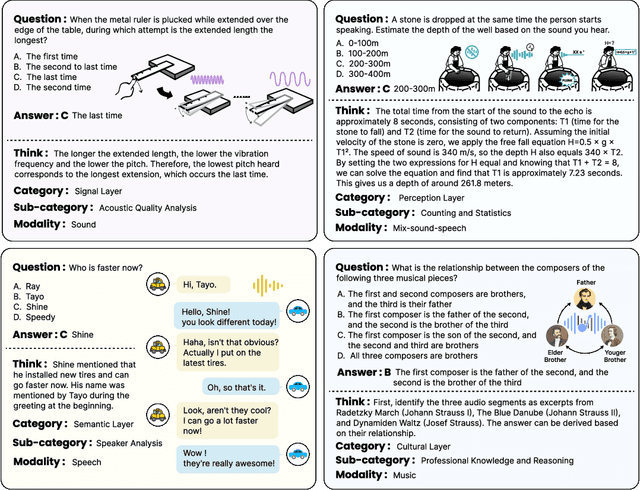
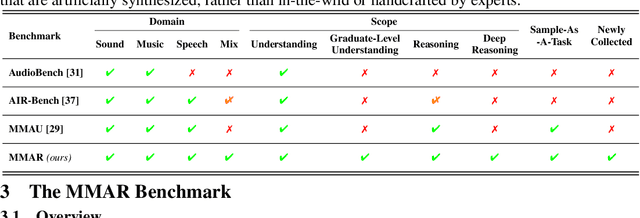
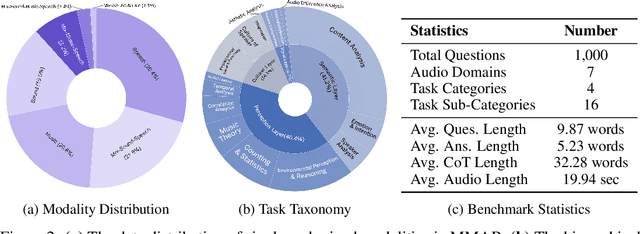
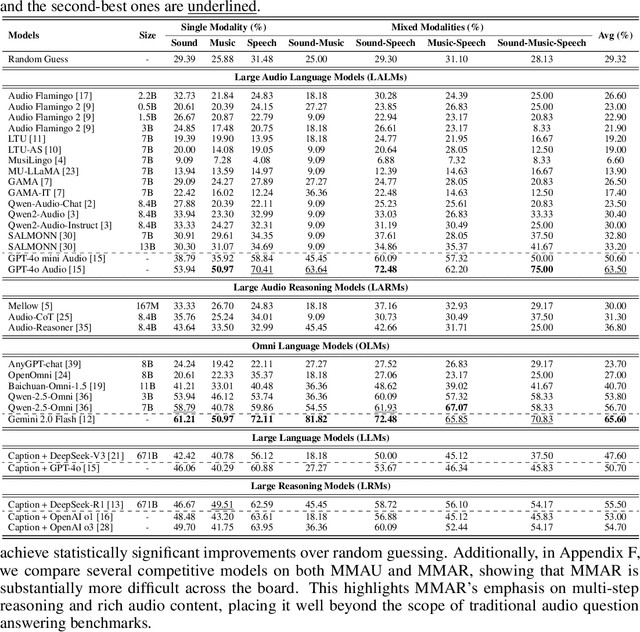
We introduce MMAR, a new benchmark designed to evaluate the deep reasoning capabilities of Audio-Language Models (ALMs) across massive multi-disciplinary tasks. MMAR comprises 1,000 meticulously curated audio-question-answer triplets, collected from real-world internet videos and refined through iterative error corrections and quality checks to ensure high quality. Unlike existing benchmarks that are limited to specific domains of sound, music, or speech, MMAR extends them to a broad spectrum of real-world audio scenarios, including mixed-modality combinations of sound, music, and speech. Each question in MMAR is hierarchically categorized across four reasoning layers: Signal, Perception, Semantic, and Cultural, with additional sub-categories within each layer to reflect task diversity and complexity. To further foster research in this area, we annotate every question with a Chain-of-Thought (CoT) rationale to promote future advancements in audio reasoning. Each item in the benchmark demands multi-step deep reasoning beyond surface-level understanding. Moreover, a part of the questions requires graduate-level perceptual and domain-specific knowledge, elevating the benchmark's difficulty and depth. We evaluate MMAR using a broad set of models, including Large Audio-Language Models (LALMs), Large Audio Reasoning Models (LARMs), Omni Language Models (OLMs), Large Language Models (LLMs), and Large Reasoning Models (LRMs), with audio caption inputs. The performance of these models on MMAR highlights the benchmark's challenging nature, and our analysis further reveals critical limitations of understanding and reasoning capabilities among current models. We hope MMAR will serve as a catalyst for future advances in this important but little-explored area.
YuE: Scaling Open Foundation Models for Long-Form Music Generation
Mar 11, 2025We tackle the task of long-form music generation--particularly the challenging \textbf{lyrics-to-song} problem--by introducing YuE, a family of open foundation models based on the LLaMA2 architecture. Specifically, YuE scales to trillions of tokens and generates up to five minutes of music while maintaining lyrical alignment, coherent musical structure, and engaging vocal melodies with appropriate accompaniment. It achieves this through (1) track-decoupled next-token prediction to overcome dense mixture signals, (2) structural progressive conditioning for long-context lyrical alignment, and (3) a multitask, multiphase pre-training recipe to converge and generalize. In addition, we redesign the in-context learning technique for music generation, enabling versatile style transfer (e.g., converting Japanese city pop into an English rap while preserving the original accompaniment) and bidirectional generation. Through extensive evaluation, we demonstrate that YuE matches or even surpasses some of the proprietary systems in musicality and vocal agility. In addition, fine-tuning YuE enables additional controls and enhanced support for tail languages. Furthermore, beyond generation, we show that YuE's learned representations can perform well on music understanding tasks, where the results of YuE match or exceed state-of-the-art methods on the MARBLE benchmark. Keywords: lyrics2song, song generation, long-form, foundation model, music generation